
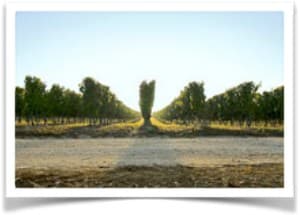
When visitors are asked what surprised them most at Clos de Pougette, the answer is often the same: the pigs. Several pigs help tend the vineyard by grazing between the rows, and it has become a visual signature of the estate. But behind the surprising image, there is an agronomically and ecologically coherent practice we want to detail.
Why pigs in a vineyard?
Not an aesthetic whim, but a practical answer to several problems any organic operation faces:
Vegetation between rows. In organic, no chemical weeding. So you have to pass the tractor several times a season — costing diesel, compacting soil, emitting CO₂.
Soil fertilisation. Without synthetic fertilisers, you look for natural solutions: compost, manure, cover crops. Pigs fertilise directly through droppings rich in organic nitrogen.
Soil aeration. The pigs' regular passage and rooting gently turns the topsoil — without the downsides of deep mechanical tillage.
Biodiversity. A plot with animals attracts insects, birds, natural predators. A whole ecosystem reinstalls itself.
How it actually works
Our pigs are moved regularly between plots, depending on the vines' needs and their behaviour. Typical calendar:
- Winter and early spring: they can stay long on a plot, grass is rare, they mostly eat residues and root the soil.
- Late spring and summer: more frequent moves to follow grass growth.
- Before veraison (mid-July to mid-August): they are removed so as not to be tempted by the ripening grapes. Critical step.
- After harvest: they can return — leftover grapes, canes, herbs.
Measurable benefits
On the plots concerned, we observe:
- Fewer tractor passes per season.
- Less aggressive grass, more diversified (pigs eat dominant grasses, leaving room for others).
- Livelier soil to the touch: more friable on top, more earthworms.
- Healthy vine behaviour — no sign of deficiency or stress tied to pigs.
Agronomically, no INRA-quality scientific hindsight yet — but daily observation confirms the interest.
The challenges this poses
Honestly, no miracle:
- More supervision. A herd lives. You watch it daily, plan watering, supplementary feed, shelter.
- Health management: a pig can transmit diseases. Protocols and vet follow-up needed.
- Risks on some plots. Young vines or unstable soils don't suit.
- Commercial acceptance. Some clients first wonder if it "contaminates" the wine. Of course not — but you have to explain.
The Instagram videos
To see our pigs in action, we regularly post on Instagram:
These videos are our best way to explain the practice to people discovering it.
What it changes for the wine
The legitimate question: does it change the taste? Honest answer: no, not directly. But indirectly:
- A more living soil → deeper roots → more terroir-expressive grapes.
- Fewer tractor passes → less compaction → better drainage → healthier vine.
- More biodiversity → better disease resilience → fewer treatments (even organic).
Over 5 or 10 years, these effects compound. We sincerely believe the Cahors from these plots in a decade will be deeper, tighter, more alive than from a standard soil.
A practice for the future?
Pasture-based animal husbandry integrated with cropping is called, in agronomic literature, silvopastoralism or integrated farming. The approach is increasingly discussed as regenerative viticulture emerges as the next step beyond organic.
A few pioneering vineyards worldwide test similar practices (sheep in Australia and Burgundy, geese in the Loire, cattle in Champagne). Still marginal, but growing.
In short
Having pigs in the vineyard isn't a gimmick. It's a coherent answer to questions every organic viticulture asks: how do you fertilise without synthetic fertilisers? How do you weed without diesel or glyphosate? How do you bring living back into often-impoverished soils?
At Clos de Pougette, we do it out of conviction, common sense, and — let's say it — because it brings real joy every day. Watching pigs graze peacefully between the rows at sunset is an image that does good.
To see what this means in organic terms, read our Organic farming page. To meet the pigs in person, contact us.